
 HOVER TO ZOOM
Longitudinal Compressometer
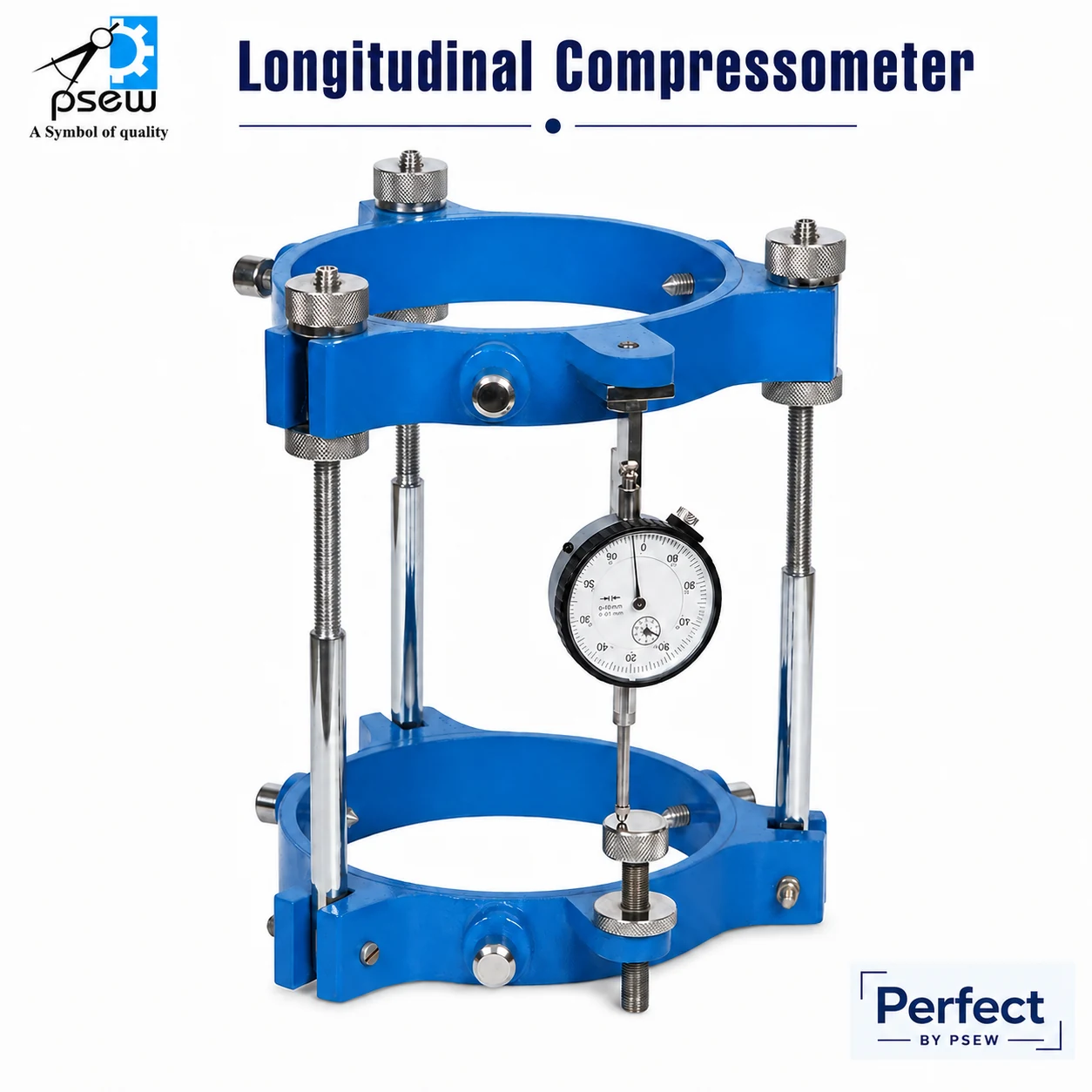
The Compressometer is used to measure the longitudinal (axial) strain of a concrete cylinder specimen under compressive load, allowing the modulus of elasticity of concrete to be determined. The instrument is clamped onto the specimen at a fixed gauge length, and dial gauges or digital sensors record the change in length as load is applied incrementally in a compression testing machine, from which stress-strain behaviour and elastic modulus are calculated.
The apparatus is used for determination of the strain and deformation characteristics of cement concrete cylindrical specimens of 150 mm dia x 300 mm length. The Compressometer consists of two frames for clamping to the specimen by means of five tightening screws with hardened and tapered ends. Two spacers hold the two frames in position. An adjustable pivot rod rests on pivot screws. A spring enables the pivot rod to remain in contact with pivot screws. The ball chain is for adjusting the tension of the spring. A dial gauge, fixed to a bracket, fitted to the top frame, is used for taking deformation measurement.
With dial gauge analogue 0.002×5mm or Dial Gauge Digital 0.001×25 mm.
| Standard Conformity | ASTM C469 |
| Gauge Length | 150 mm x300mm concrete cylinder specimens |
| Measurement | Dial gauges 0.002x5mm or digital 0.001x25mm |
| Application | Modulus of elasticity (longitudinal strain) testing of concrete cylinders |